Pune saved 1.27 million litres of fuel in 102 days
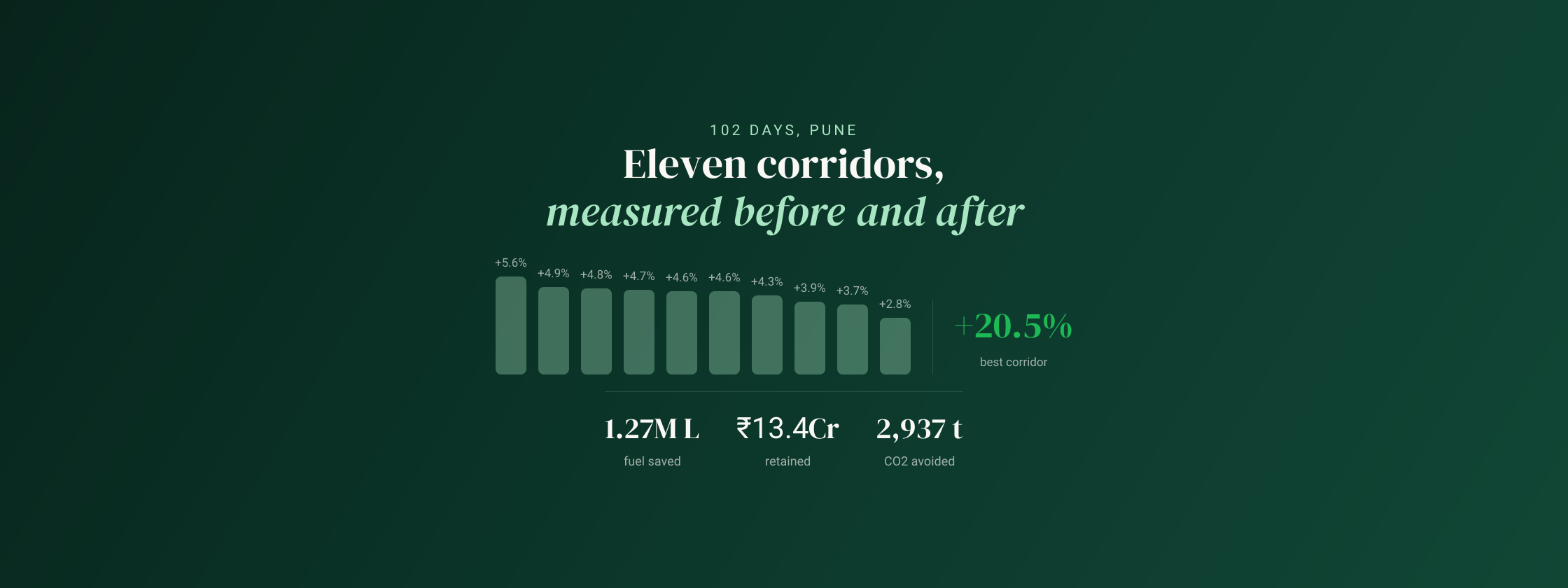
102 days with Pune City Police: 39,734 congestion build-ups cleared, 1.27 million litres of fuel saved, ₹13.4 crore retained, 2,937 tonnes of CO₂ avoided.

In the first week of May 2026, the Honourable Prime Minister Shri Narendra Modi asked the country to find practical ways to reduce its fuel consumption. Most of the public conversation that followed focused on individual choices: car-pooling, walking for short errands, switching to electric two-wheelers. These are valuable, but they scale slowly.
There is a second mechanism that operates at city scale, requires no behaviour change from citizens, and can be delivered in months rather than decades: reducing the time vehicles spend stuck in congestion. Every minute a vehicle idles, fuel is burned. Every kilometre travelled in stop-and-go traffic burns 30 to 50 percent more fuel than the same kilometre in free flow. If a city can move the same volume of vehicles with less idling and less stop-start, it saves fuel automatically.
This is a record of what one Indian city, Pune, saved over the first 102 days of operating the TraffiCure traffic-intelligence platform with Pune City Police.
What the platform did
TraffiCure ingests the Google Roads Management Insights probe-data feed, compiled from the anonymised, aggregated movement of more than a billion Google Maps users and refreshed every two minutes. On top of that feed, the platform watches for unusual slowdowns and surfaces congestion build-ups on a dashboard used by the Pune City Police traffic control room.
A duty officer can then dispatch a constable, override a signal cycle, push a re-routing message, or log the situation for review. The platform sees the entire city continuously, so build-ups are identified earlier than they would be from phoned-in complaints or fixed cameras. It requires no new hardware, no roadside sensors, and no new tenders.
Between 1 February and 12 May 2026, the platform monitored approximately 998 kilometres of city road across 119 named corridors. Probe-data coverage averaged 97.3 percent of every hour, every day. The platform surfaced 39,734 distinct congestion build-ups. Pune City Police closed every one. The median build-up was cleared 26 minutes after it was first identified.
How we measured the change
To assess whether continuous operation was translating into better outcomes on the road, we compared two fortnights. The early window is 9 to 22 March 2026, by which point the platform had been live for roughly five weeks. The late window is 27 April to 10 May 2026, the most recent two complete weeks before publication. Within each window we restricted attention to peak commuting hours: 8:00 to 11:00 in the morning, 17:00 to 21:00 in the evening, weekdays only.
Two clarifications. First, we are not claiming Pune's traffic improved everywhere. Averaged across the entire 998 km network, peak speeds were broadly flat. Pune's vehicle population is growing rapidly; city-scale speed gains would require intervention on every corridor. The platform's job is to direct police attention to where it will have the most effect. Second, while we use the same comparison windows for every corridor, the platform itself has been operating continuously, and many gains have been building incrementally throughout the period.
The eleven corridors where speeds rose
Eleven corridors stood out. On each, the police had logged a meaningful volume of intervention activity during the study period, and on each, peak-hour speeds were measurably higher in the April-May window than in the March window.
| Corridor | Length | March | Apr-May | Gain |
|---|---|---|---|---|
| Taddigutta Chowk → National War Memorial | 3.78 km | 21.9 kmph | 26.4 kmph | +20.5% |
| Golibar Maidan → Khadi Machine Chowk | 6.09 km | 27.4 kmph | 28.7 kmph | +4.9% |
| Sancheti Hospital → Rajiv Gandhi Bridge | 4.39 km | 31.5 kmph | 32.7 kmph | +3.7% |
| Shahir Amar Chowk → Gadgil Putla Chowk | 1.37 km | 22.6 kmph | 23.9 kmph | +5.6% |
| Veer Chaphekar Chowk → Shimala Chowk | 1.17 km | 21.9 kmph | 23.0 kmph | +4.8% |
| Alka Talkies Chowk → Jedhe Chowk | 1.99 km | 21.6 kmph | 22.6 kmph | +4.7% |
| Mundhwa → Keshavnagar → Kolwadi | 11.19 km | 21.9 kmph | 22.9 kmph | +4.6% |
| Teen Tofa → Sent Merry | 1.43 km | 21.1 kmph | 22.0 kmph | +4.6% |
| Wagholi → Kesnand | 1.74 km | 23.8 kmph | 24.8 kmph | +3.9% |
| Bhumkar Chowk → Katraj Chowk | 2.81 km | 20.5 kmph | 21.4 kmph | +4.3% |
| ABC Farm → Airport (Ramwadi) | 3.42 km | 28.9 kmph | 29.7 kmph | +2.8% |
Source: TraffiCure production database. Peak hours 8:00 to 11:00 and 17:00 to 21:00, weekdays only.
From speed to fuel, one worked example
Take the first corridor, Taddigutta Chowk to the National War Memorial, 3.78 kilometres long. In the March window, the average peak-hour speed of 21.9 kmph meant a commuter traversing the full corridor took approximately 10 minutes 21 seconds. In the April-May window, the same corridor running at 26.4 kmph takes 8 minutes 35 seconds. That is 1 minute 46 seconds saved per peak-hour traversal, per commuter, every weekday.
Indian arterials typically carry between 2,000 and 3,000 Passenger Car Units per hour per direction during peak periods. We adopt 2,000 PCU per hour per direction as a conservative working assumption. With seven peak hours per weekday and two directions, that translates into roughly 28,000 vehicle-traversals per corridor per weekday during peak. Combined with the per-traversal time savings across all eleven corridors, the result is roughly 186,000 vehicle-hours of peak-time congestion avoided over the 102-day period.
At a Pune-mix congestion fuel-burn rate of 0.8 litres per vehicle-hour, that translates to approximately 148,000 litres of petrol saved on the eleven corridors alone, ₹1.56 crore at the May 2026 retail price of ₹105 per litre, and 343 tonnes of carbon dioxide kept out of Pune's air. This is the strict, observation-anchored figure, counting only direct, measurable speed gains, only during peak hours, with conservative volume assumptions.
Beyond the eleven corridors, the broader estimate
The corridor analysis above is conservative in two important ways. First, peak-hour average speed is a coarse measure. A jam that would have lasted an hour and spread to neighbouring streets, but is cleared in 20 minutes because the platform surfaced it, registers only weakly in the average. Its actual effect on fuel consumption is substantial. Second, the eleven corridors are a small fraction of the monitored network. The platform watched 998 kilometres of road and surfaced 39,734 separate build-ups during the period, each a localised intervention that did not show up in corridor-wide speed averages but nonetheless saved real commuter time.
We therefore present a second, broader estimate, based on the volume of congestion the police were able to clear. Each of the 39,734 build-ups represents a real, observable event. Without the platform, the majority of these events would not have been raised to the police's attention in time. The congestion would have continued to grow until either it dissipated on its own or someone in the affected area phoned the control room. We estimate, conservatively, that the difference between a platform-flagged response and an unaided response is approximately 30 minutes of additional congestion per event. If a typical congested arterial in Pune carries 80 vehicles per minute through the affected stretch, then 30 minutes of additional congestion translates into 40 vehicle-hours of extra stop-and-go traffic per event.
Multiplied across 39,734 events, that is 1,589,360 vehicle-hours of jam avoided, 1,271,488 litres of fuel saved, ₹13.35 crore retained, and 2,937 tonnes of carbon dioxide avoided over the 102-day period. Annualised at the same rate of operation, the broader figure works out to roughly 4.55 million litres, ₹47.7 crore, and 10,500 tonnes of CO₂ per year, from a single city.
How sensitive is the broader estimate?
Three assumptions drive most of the variance: the additional jam time per event without the platform, the number of vehicles affected per minute, and the fuel-burn rate during stop-and-go. Under conservative assumptions, halving each mid-band input, the platform still produced approximately 477,000 litres of fuel savings and ₹5 crore in retained commuter spend over the period. Under aggressive assumptions, the figures roughly double. The mid-band estimate of ₹13.4 crore sits comfortably between bounds derived from public-domain sources.
What this implies for India
India has more than one hundred cities of Pune's size or larger. Applied at the same operating maturity to fifty of them, the same methodology suggests national fuel savings of approximately 230 million litres per year, retained household expenditure of approximately ₹2,400 crore per year, and avoided CO₂ emissions of approximately half a million tonnes per year.
These are illustrative figures. Actual savings will depend on local urban form, the quality of police response, and the maturity of platform adoption. But the order of magnitude is instructive. The most direct mechanism available to Indian cities for reducing citizens' fuel consumption, better traffic management, appears to deliver savings measured in thousands of crores at national scale, with no new vehicle technology required, no behaviour change asked of citizens, and no roadside hardware to procure.
The Honourable Prime Minister's call was for citizens and institutions to find practical mechanisms to reduce India's fuel consumption. On the basis of this case study, intelligent urban traffic management is one such mechanism, and the evidence from Pune supports rapid extension to other Indian cities.
Calculate your share
The whitepaper works at city scale. The same physics works at commuter scale. If you live or work in Pune, you can estimate your own annual share of fuel, time, and rupees lost to peak-hour congestion using the same model.
Read the full case study
- Pune fuel savings whitepaper (PDF, 18 pages) with methodology, sensitivity analysis, and full assumptions.
- Two-page executive brief (PDF).
Sources include the TraffiCure production database, vehicle fuel-consumption rates published by the Automotive Research Association of India, the Centre for Science and Environment, and TERI, Indian Oil Corporation's May 2026 Pune retail prices, and the IPCC default petrol emission factor of 2.31 kg of CO₂ per litre. Lepton Software thanks Pune City Police for the operational partnership that made this study possible.
Frequently asked questions
How much fuel did Pune save with TraffiCure in 102 days?
Approximately 1.27 million litres of fuel, equivalent to ₹13.4 crore in retained commuter spending and 2,937 tonnes of avoided CO₂ emissions, between 1 February and 12 May 2026.
How many congestion build-ups did Pune City Police clear?
39,734 distinct congestion build-ups surfaced by the platform across 998 kilometres of monitored road. The median build-up was cleared 26 minutes after first identification.
How was the fuel saving estimate calculated?
Observed peak-hour speed gains on eleven corridors were converted to vehicle-hours saved using 2,000 PCU per hour per direction, then multiplied by a Pune-fleet-weighted congestion fuel-burn rate of 0.8 litres per vehicle-hour from ARAI, CSE, and TERI research. Broader network savings use a conservative 30-minute counterfactual jam-time per cleared event.
Does TraffiCure require new cameras or roadside hardware?
No. TraffiCure uses the Google Roads Management Insights probe-data feed, compiled from the anonymised movement of more than a billion Google Maps users and refreshed every two minutes. No new cameras, sensors, or roadside equipment are required.
Can the same fuel savings be achieved in other Indian cities?
Applied at the same operating maturity to fifty Indian cities of Pune's scale, the methodology suggests national fuel savings of approximately 230 million litres per year, ₹2,400 crore in retained household expenditure, and around half a million tonnes of avoided CO₂ annually. Actual savings depend on local urban form, police response quality, and platform adoption.
TraffiCure delivers real-time traffic intelligence for every road in your city, on existing data, with no civil work. See all features or book a demo to see your city's data.